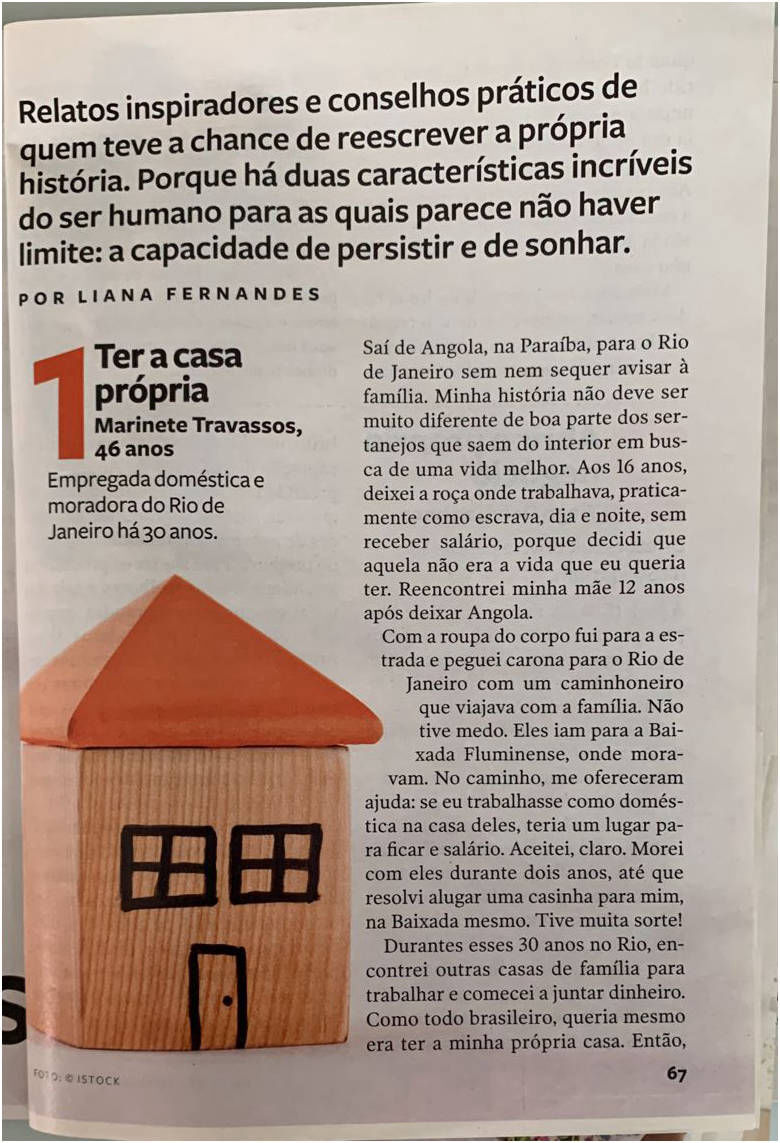
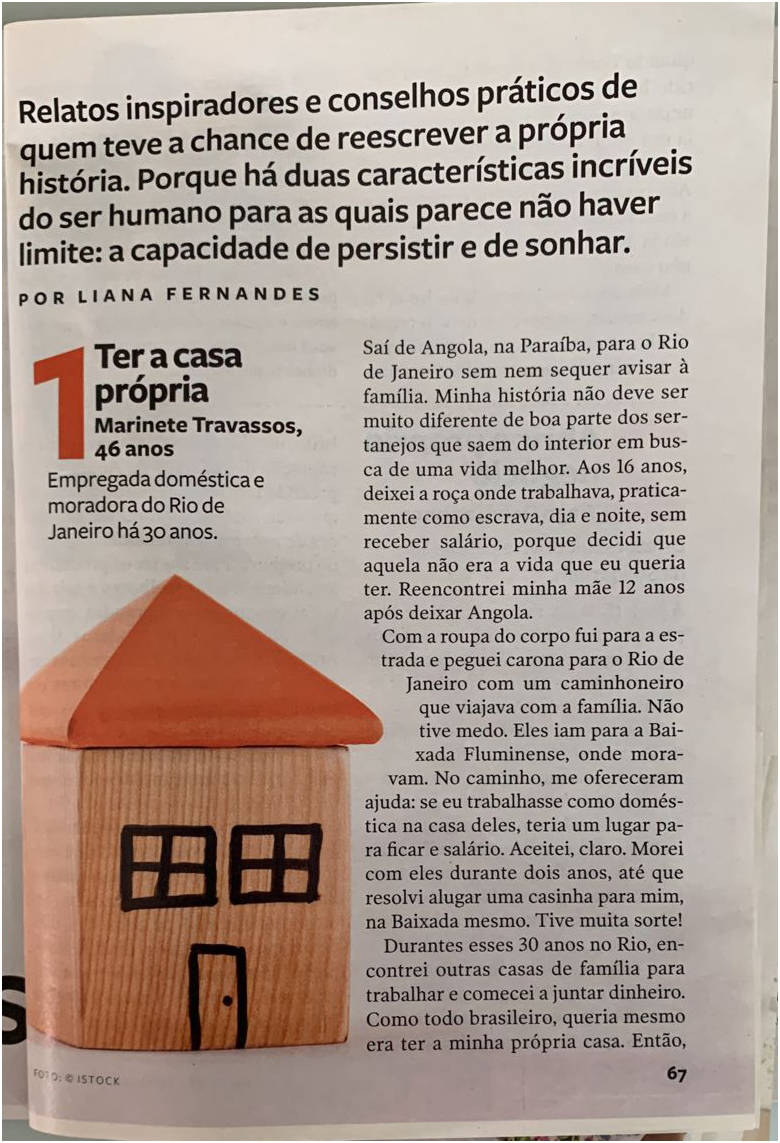
Marinete Travassos, 46 years old: maid and resident of Rio de Janeiro for 30 years.
I left Angola, in Paraíba, for Rio de Janeiro without even telling my family. My story shouldn’t be very different from most country people who leave the interior in search of a better life. At the age of 16, I left the farm where I used to work, practically like a slave, day and night, without receiving a salary, because I’ve decided that that wasn’t the life I wanted to have. I’ve met my mother again just 12 years after leaving Angola.
Only with the clothes I was wearing that day, I’ve headed to the road and got a ride to Rio de Janeiro with a truck driver who was traveling with his family. I remember I was not afraid of anything. They were going to Baixada Fluminense, where they used to live. On the way, they offered me help: if I worked as a maid in their house, I would have a place to stay and a salary. I accepted, of course. I’ve lived with them for two years, until I’ve decided to rent a small place for myself, in Baixada. I must confess, I was very lucky!
During these 30 years in Rio, I’ve found other family homes to work for and started to save money. Like every Brazilian, I really wanted to buy my own house. So, when I’ve met Lenildo, my husband for seven years, we’ve started planning our house, since he already owned land in the Boa Esperança neighborhood, in Duque de Caxias. Little by little we bought the materials and in two years the house was ready. But still, I wanted to buy my house…
Once again, I’ve saved money and, just two months ago, I bought a land! I’m proud because I managed to do it with the money from my work, by myself. Every 15 days I buy part of the construction material. My house is already being built, right there, in Boa Esperança. It’s a peaceful place and I think the house will be ready by the end of this year. It will be small, but what matters is the house will be mine!
Advice: Work hard and be honest. Don’t build anything on someone else’s land and legalize the documentation so that you don’t lose your future home or the money you have invested.
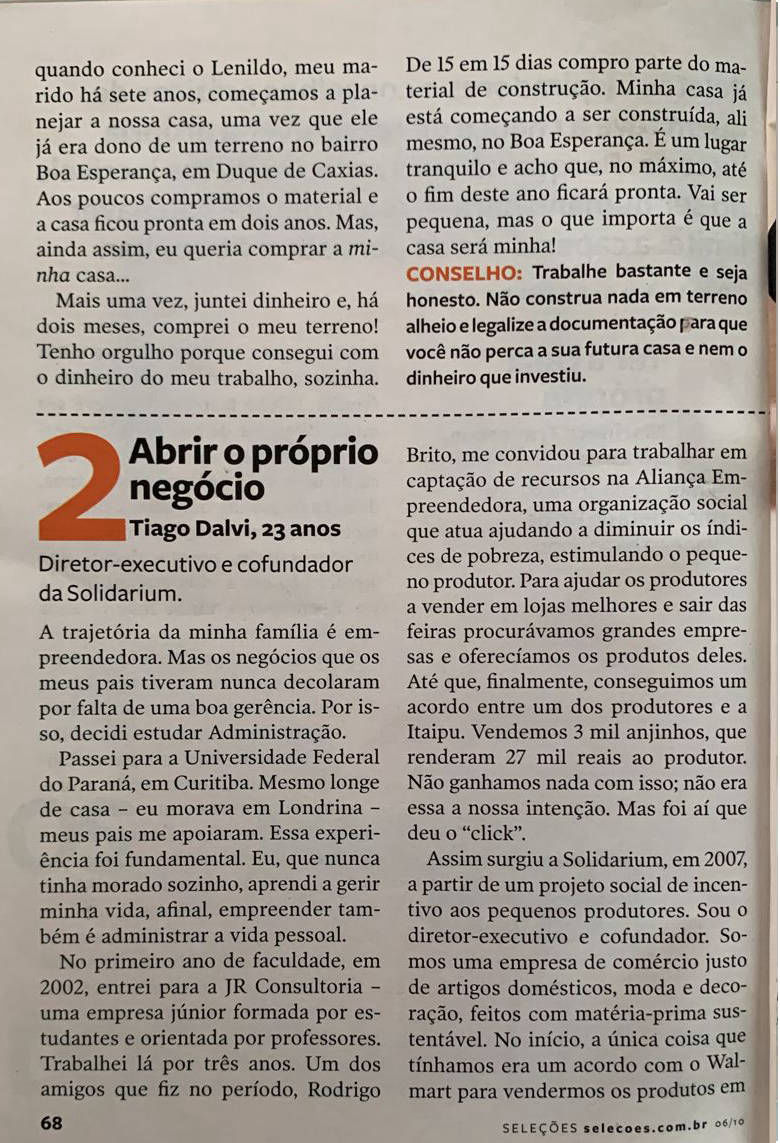
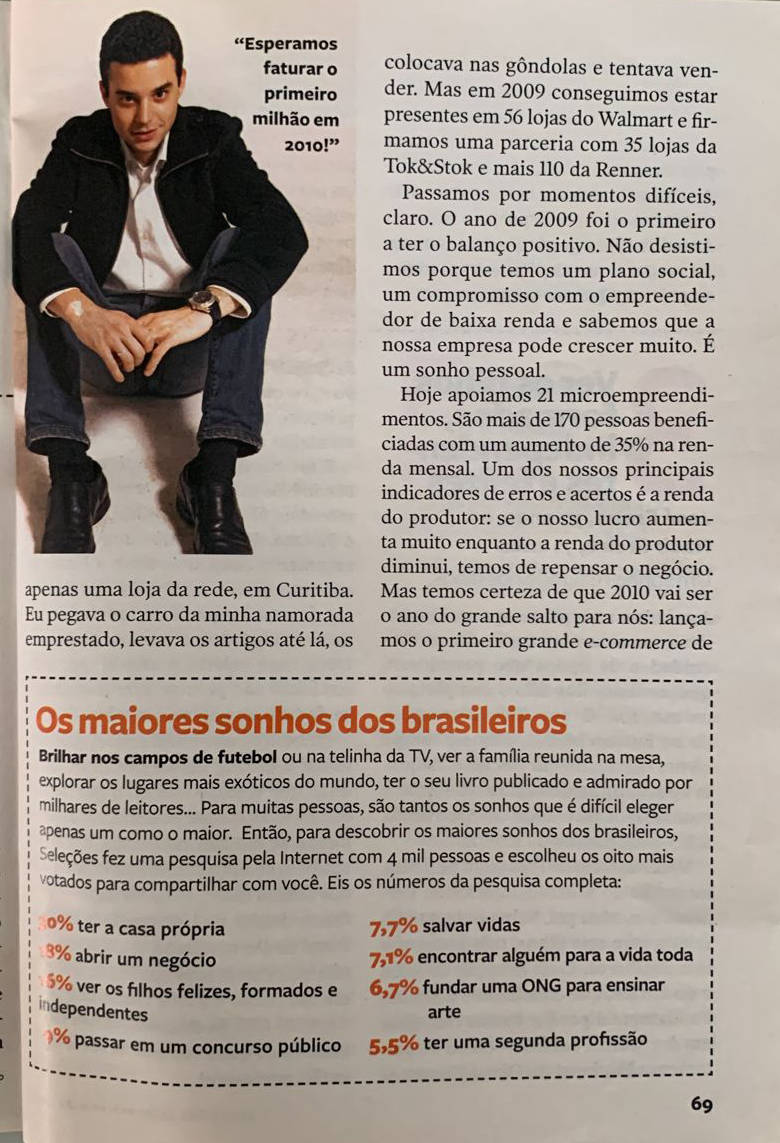
Tiago Dalvi, 23 years old: executive director and co-founder of Solidarium.
My family’s trajectory is entrepreneurial. My father have even opened a factory
toys and my mother, who is an engineer, have settled up her own office. But those business were not successful due to lack of good management and, therefore, I decided to study Administration.
I’ve studied in the Federal University of Paraná, in Curitiba. Even though it was far from home – I used to live in Londrina – my parents have supported me. This experience was fundamental. I, who had never lived alone, had to learn how to manage my life, after all, being an entrepreneur also means managing your life.
In my first year of the university, in 2002, I met and joined JR Consultoria – a junior company formed by students and guided by professors. I’ve worked there for three years. One of the friends I’ve made during that period, Rodrigo Brito, invited me to work in fundraising resources at Aliança Empreendedora, a social organisation that helps to reduce poverty rates, encouraging small producers. And to encourage them to sell in better stores and leave the informal markets, we used to look for big companies and offer their products. Finally, one day we’ve got an agreement between one of the producers and the Itaipu company. We’ve sold 3 thousand little angels, which paid to the producer 27 thousand Brazilian reais. We’ve got no money from it; that was not our intention. But that’s when it “clicked” in our mind.
This is how Solidarium was created, in 2007. From a social project to encourage small producers. I’m the executive director and co-founder. We are a fair trade company selling household, fashion and decoration items, made with sustainable raw materials. At the beginning, the only thing we had was an agreement with Walmart to sell the products in just one store in the chain, in Curitiba. I used to borrow my girlfriend’s car, take the items there, put them on the shelves and try to sell them. But in 2009, we managed to be present in 56 Walmart stores and signed partnerships with Tok&Stok and another 110 Renner stores.
We’ve been through difficult times, of course. The year 2009 was the first to have a positive balance. We haven’t given up because we have a social plan, a commitment to low-income entrepreneurs and we know that our company can grow a lot. It’s a personal dream.
Nowadays we support 21 micro-enterprises. More than 170 people benefited from a 35% increase in monthly income. One of our main indicators of successes and errors is income: if our profit increases a lot while the producer’s income decreases, we have to rethink the business. But we are sure that 2010 will be the year of the big leap for us: we’ve launched the first major fair trade e-commerce in Brazil and we hope to make our first million this year.
If I hadn’t counted on my parents’ financial and moral support during university, when I wasn’t making any money, I might not have opened my own business. I believe that we only change something in the world if we generate true results in practice. When I talk to a producer and see that we are changing their life, I know we are doing a good job.
Advice: Solidarium was successful because we shared the idea with many people.
Anyone who dreams of opening their own business should seek different opinions, research their sector and learn how to use management tools. And, of course, always try to be number 1.
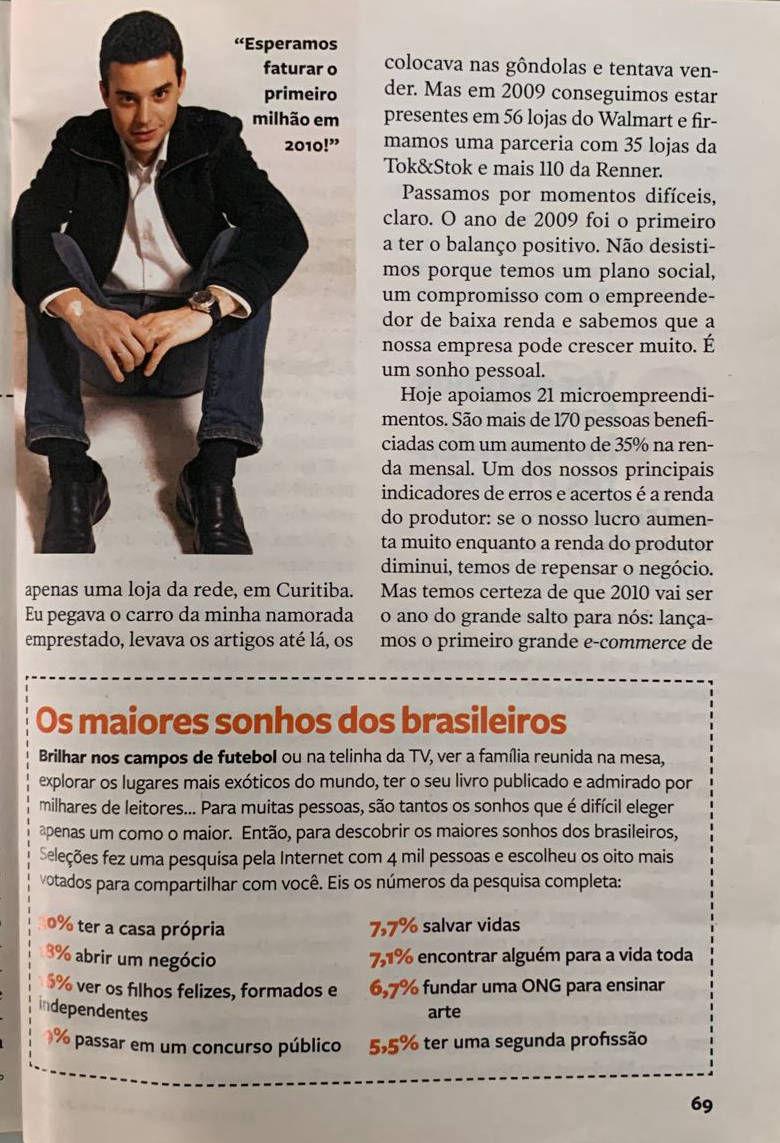
30% Buying their own home
7.7% Saving lives
18% Opening their own business
7.1% Finding the love of their lives
16% Seeing your children graduated, independent and happy
6.7% Creating a NGO to teach art
9% Being accepted to work for the Government
5.5% Working in a second profession
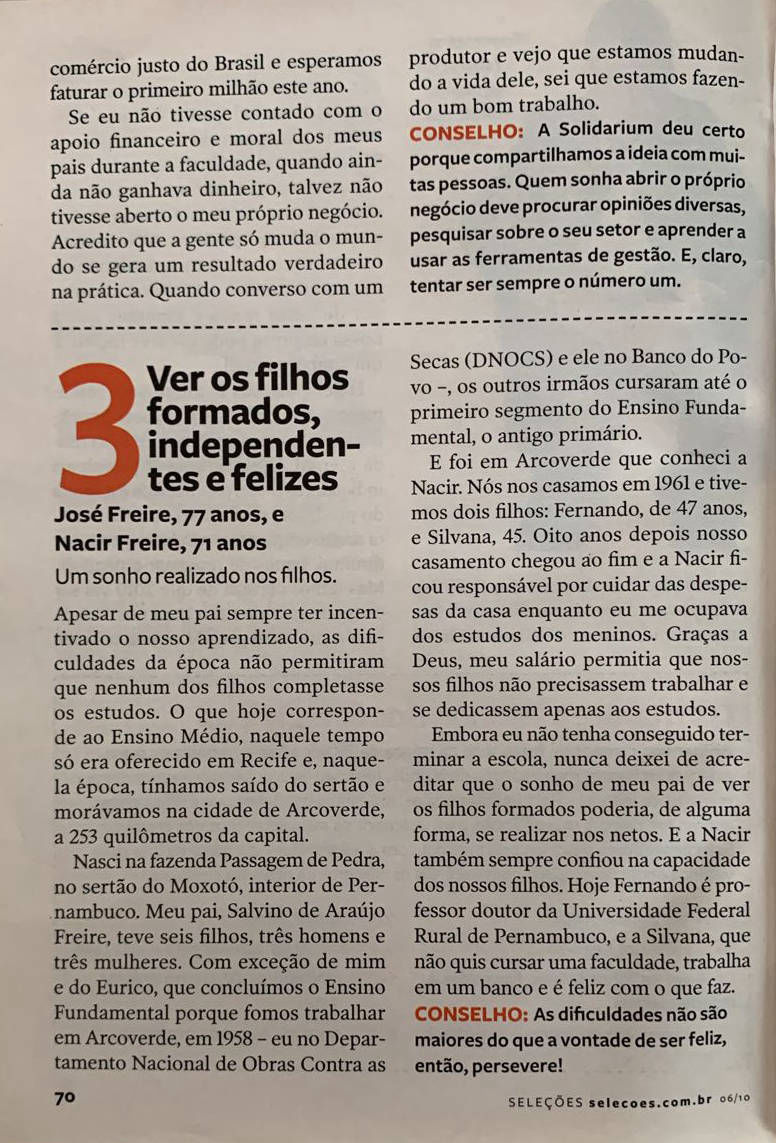
José Freire, 77 years old and Nacir Freire, 71 years old: a dream come true in their children.
Although my father always encouraged our learning, the difficulties of the time did not allow his children to complete their studies. What today corresponds to High School, at that time was only offered in Recife (capital) and, at that time, we had left the backlands and lived in the city of Arcoverde, 253 km from the capital.
I was born on the Passagem de Pedra farm, in the backlands of Moxotó, in the interior of Pernambuco. My father, Salvino de Araújo Freire, had six children, three men and three women. With the exception of me and Eurico, who completed elementary school because we went to work in Arcoverde, in 1958 – me at the National Department of Works Against Droughts (DNOCS), and he at Banco do Povo –, the other brothers studied up to the first segment of Elementary Education, formerly primary.
And it was in Arcoverde that I met Nacir. We got married in 1961 and had two children: Fernando, 47 years old, and Silvana, 45. Eight years later, our marriage came to an end and Nacir got responsible for taking care of the household expenses while I took care of the boys’ studies. Thank God, my salary was enough for our children only dedicate themselves to studying.
Although I was unable to finish school, I never stopped believing that my father’s dream of seeing his children graduate could, in some way, come true in his grandchildren. And Nacir has also always trusted in our children’s abilities. Today Fernando is a professor at the Federal Rural University of Pernambuco, and Silvana, who didn’t want to go to the university, works in a bank and is happy with what she does.
Advice: Difficulties are no greater than the desire to be happy, so persevere!
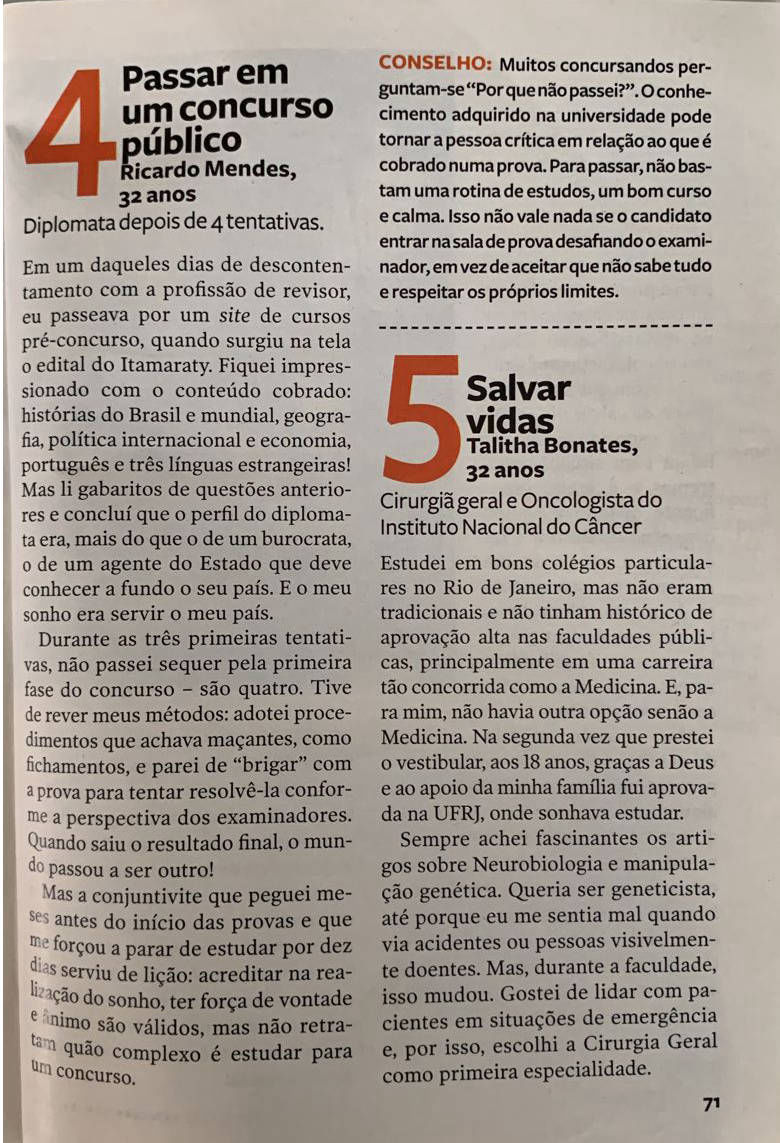
Ricardo Mendes, 32 years old: a Diplomat after 4 attempts.
On one of those days of dissatisfaction with the proofreading profession, I was browsing an exams website, when the Itamaraty notice appeared on the screen. I was impressed with the content someone should know: Brazilian and world histories, Geography, international politics and economics, Portuguese and three foreign languages! But I’ve read the answers to previous questions and concluded that the diplomat’s profile was, more than that of a bureaucrat, that of a State agent who must know his country in depth. And my dream was to serve my country.
During the first three attempts, I didn’t even pass the first phase of the competition – there are four. I had to review my methods: I’ve adopted procedures that I used to find boring, such as notes, and I’ve stopped “fighting” with the tests to try to solve it according to the examiners’ perspective. When the final result came out, the world became different!
But the conjunctivitis that I caught months before the exams began and that forced me to stop studying for 10 days served as a lesson: believing in the realisation of the dream, having willpower and enthusiasm were valid, but they did not portray how complex it is to study to get a place in the Brazilian Government.
Advice: Many candidates ask themselves “Why didn’t I pass?”. The knowledge acquired at university can make a person critical of what is required in a exam. To be accepted, a study routine, a good course and calmness are not enough. This is useless if the candidates enter the exam room challenging the examiner, instead of accepting that they don’t not know everything and respecting their own limits.
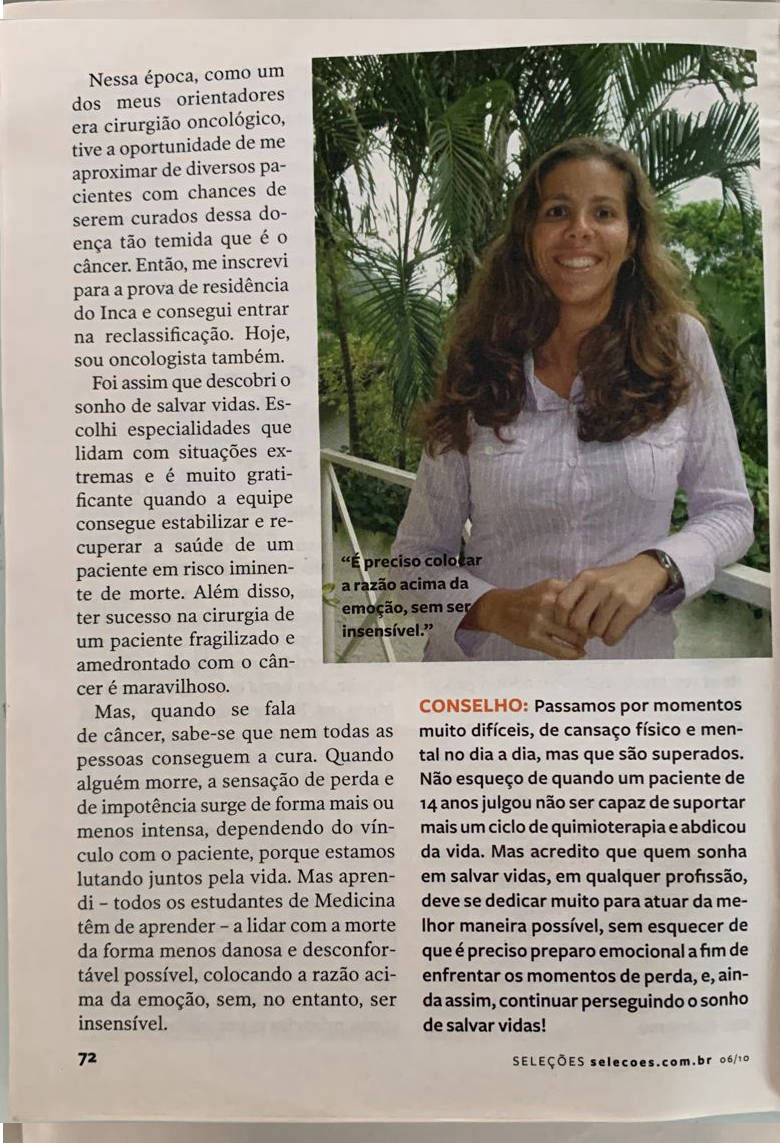
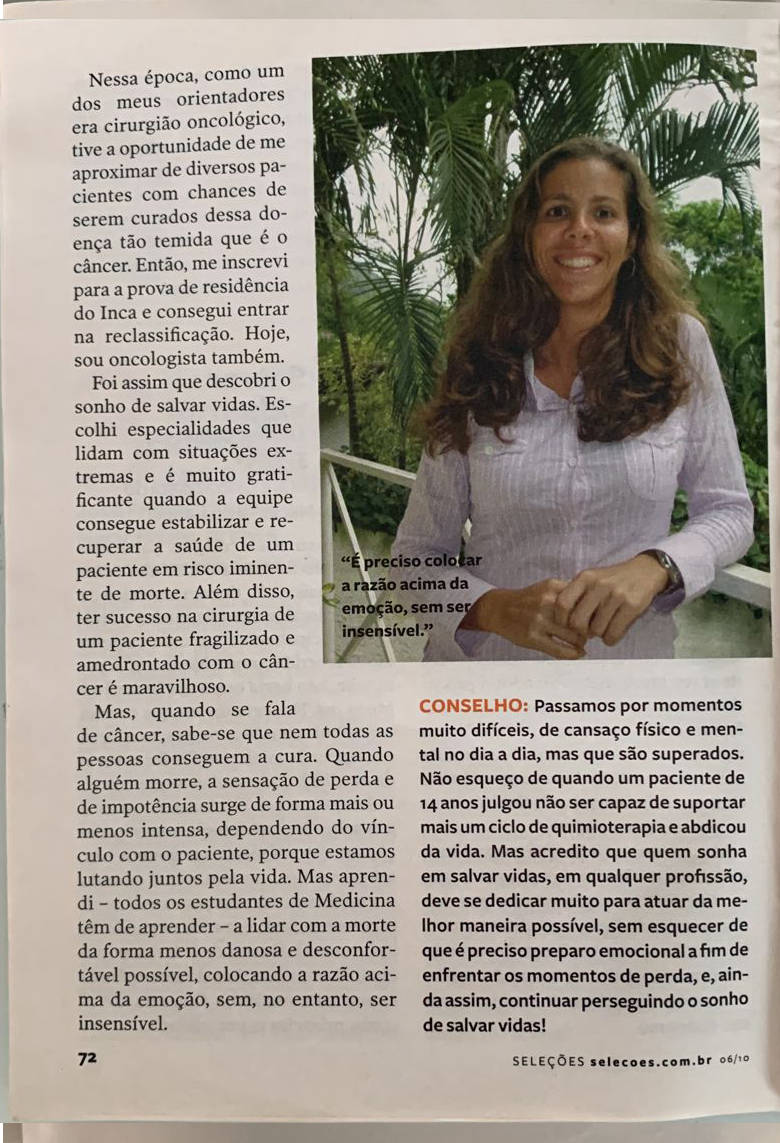
Talitha Bonates, 32 years old: General surgeon and oncologist at the National Cancer Institute (Inca).
I studied at good private schools in Rio de Janeiro, but they were not traditional, and did not have a history of high approval rates at public universities, especially in a career as competitive as Medicine. And, for me, there was no other option than Medicine. The second time I took the entrance exam, at the age of 18, thanks to God and the support of my family I was approved at Universidade Federal do Rio de Janeiro (UFRJ), where I dreamed of studying.
I have always found articles about Neurobiology and genetic manipulation fascinating. I wanted to be a geneticist, especially because I used to fell bad when I seeing accidents or people who were visibly sick. But during the university, that changed. I’ve enjoyed dealing with patients in emergency situations and, therefore, chose General Surgery as my first specialty.
At that time, as one of my guiders was an oncology surgeon, I had the opportunity to get close to several patients with a chance of being cured of this dreaded disease, cancer. So, I signed up for the Inca residency test and managed to get a place. Today, I am also an oncologist.
That’s how I discovered my dream of saving lives. I chose specialties that deal with extreme situations and it is very rewarding when the team manages to stabilise and restore the health of a patient at imminent risk of death. Furthermore, having a successful surgery on a patient who is weakened and frightened by cancer is wonderful.
But, when talking about cancer, we know that not everyone can be cured. When someone dies, the feeling of loss and impotence appears more or less intensely, depending on the bond with the patient, because we are fighting for life together. But I’ve learned – all medical students have to learn – to deal with death in the least harmful and uncomfortable way possible, putting reason above emotion, without, however, being insensitive.
Advice: We usually go through very difficult times, of physical and mental fatigue on a daily basis, but we can overcome them. I’ll never forget when a 14-year-old patient thought he was unable to endure another cycle of chemotherapy and gave up his life. But I believe that anyone who dreams of saving lives, in any profession, must dedicate themselves to performing in the best way possible, without forgetting that emotional preparation is necessary in order to face moments of loss and, even so, continue pursuing the dream of saving lives.
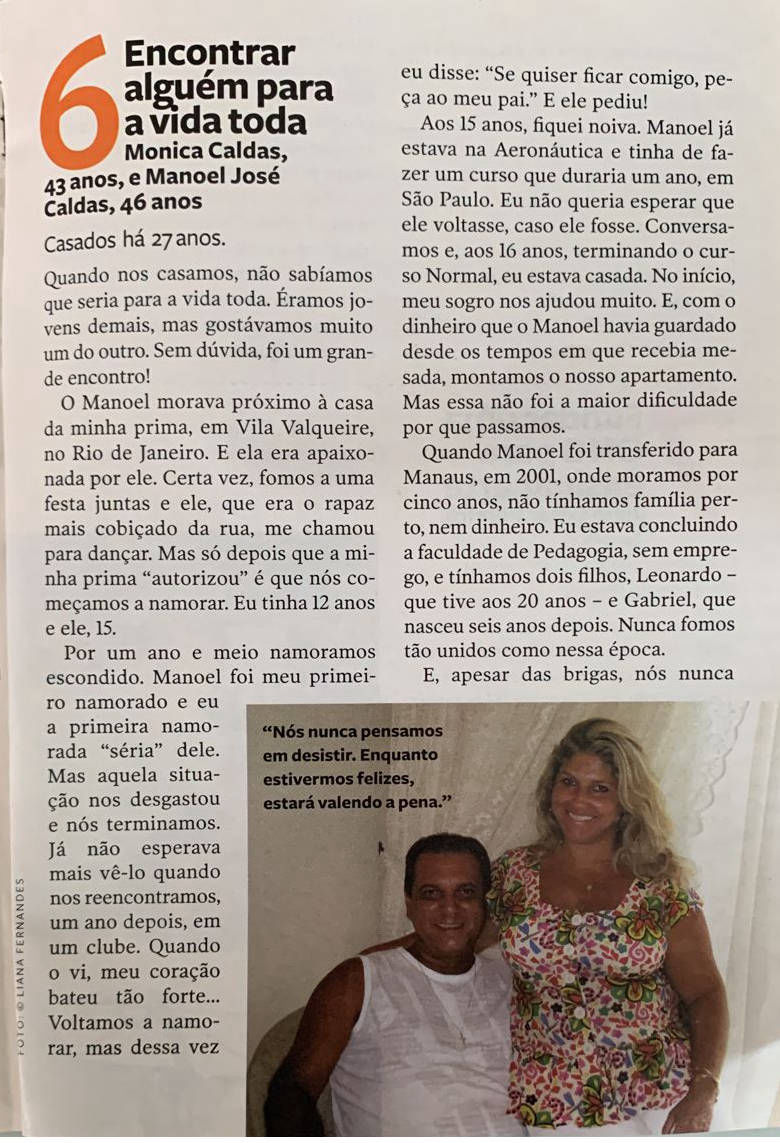
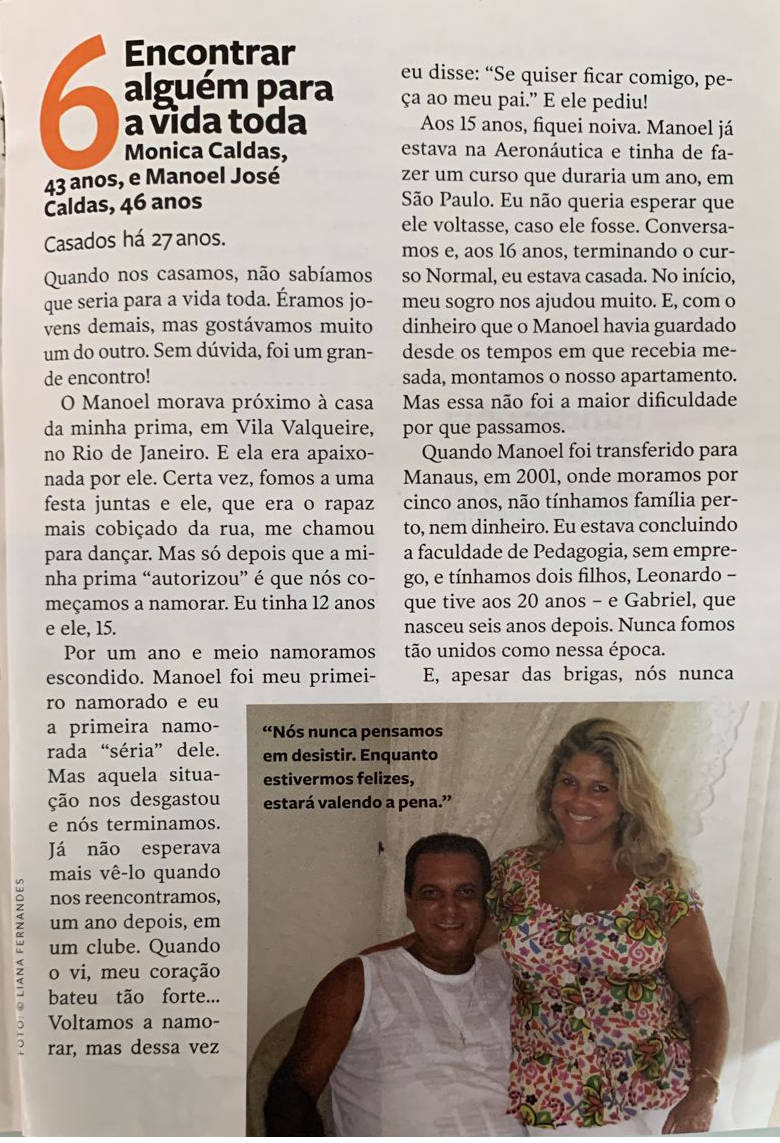
Monica Regina Meirelles Caldas, 43 years old, and Manoel José Lopes Caldas, 46 years old: married for 27 years.
When we got married, we didn’t know it would be for forever. We were too young, but we really liked each other. Without a doubt, it was a great encounter!
Manoel lived close to my cousin’s house, in Vila Valqueire, in Rio de Janeiro.
January. And by that time, she was in love with him. One day, we went to a party together and he, who was the most sought-after guy there, asked me to dance. But only after my cousin’s authorisation, we’ve started dating. I was 12 years old and he was 15.
For a year and a half we have secretly dated. Manoel was my first boyfriend and I was his first “serious” girlfriend. But that situation wore us down and we broke up. I no longer expected to see him when we met again, a year later, in a club. When I saw him, my heart beat so hard… We’ve got back together, but this time, I said: “If you want to be with me, ask my father”. And he did!
At 15, I got engaged. Manoel was already in the Air Force and had to take a course that would last one year, in São Paulo. I didn’t want to wait for him to come back, so we’ve talked about it and, at 16, at the end of a teaching course, I was married to him!
In the beginning, my father-in-law helped us a lot. And, with the money that Manoel had saved since the days when he received some money from family, we set up our apartment. But that wasn’t the hardest time we’ve had.
When Manoel was transferred to Manaus, in 2001, where we’ve lived for five years, we had no family nearby and no savings. I was completing my Pedagogy degree at the university, was unemployed, and we had two sons, Leonardo – born when I was 20 years old – and Gabriel, born six years later. We have never been as united as we were at that time.
And despite the arguments, we never thought about giving up on us. As long as we are happy, it will be worth it. In fact, for us, the happiest moment was seeing Leonardo get married, in January of this year. We have the feeling that we have fulfilled our duty. And, perhaps, we feel this moment differently because we see a bit of our own history repeating itself – he is 23 years old, in the Army, living in Manaus, and his fiancée used to live in Rio de Janeiro. They didn’t want to be apart. He found the love of his life, just like me and Manoel!
Monica’s advice: To get married, you need to be sure. If you love and found someone who makes you feel special, get married!
Manoel’s advice: Marriage is not prison. You have to marry for love, not because you are used to the person or because you have been dating for many years. If you are not looking for adventures and are complete in the relationship, there is a real chance of having found someone for life!
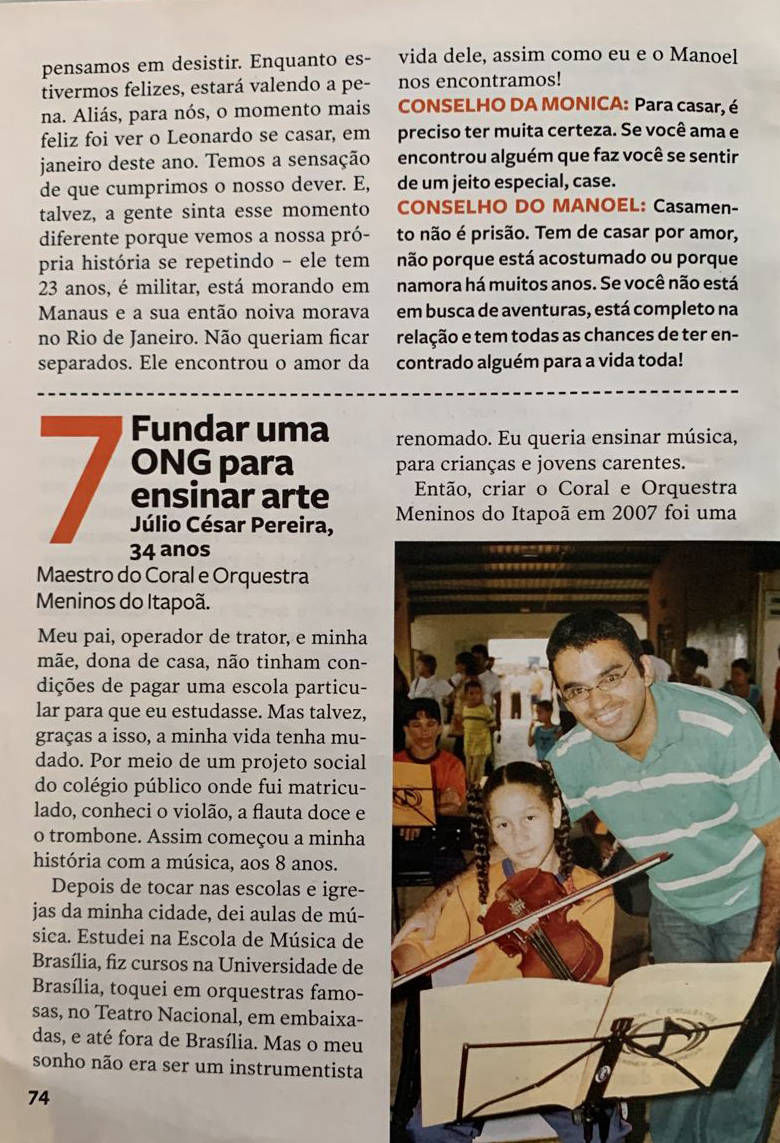
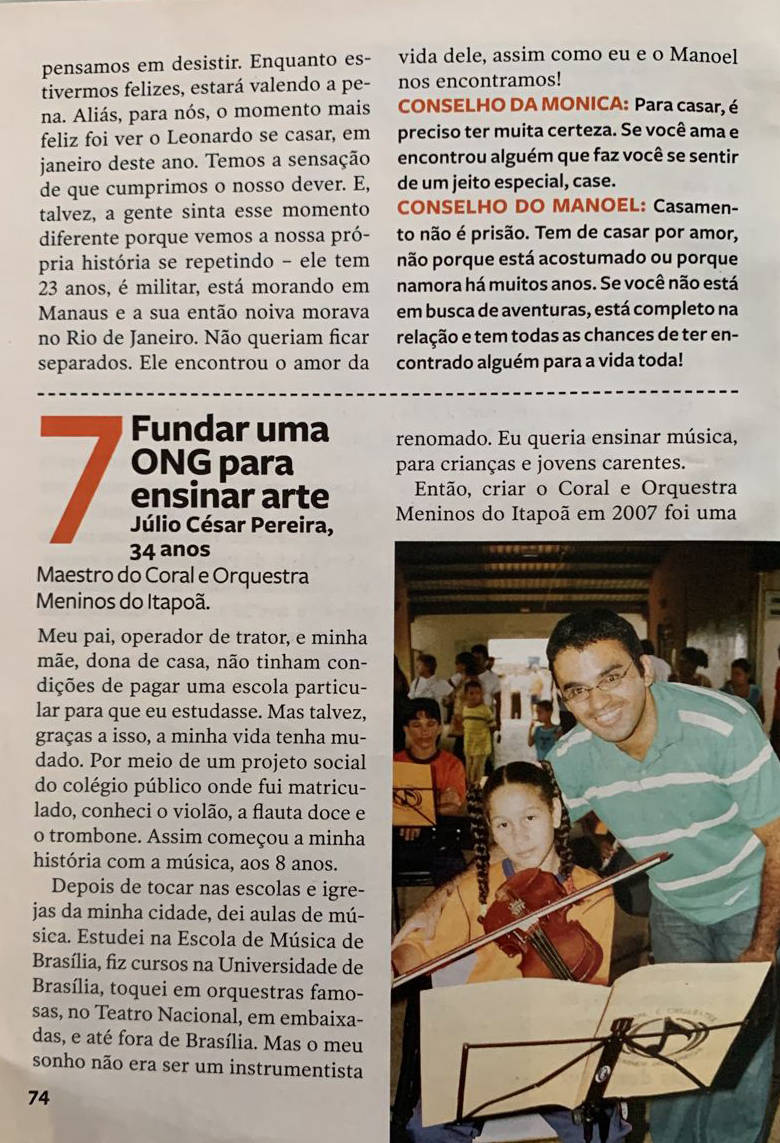
Júlio César Pereira, 34 years old: conductor of the Choir and Orquestra Meninos do Itapoã.
My father, a tractor operator, and my mother, a housewife, were unable to pay for a private school for me to study. But maybe, thanks to that, my life has changed. Through a social project at the public school where I was enrolled, I discovered the guitar, the recorder and the trombone. This is how my history with music began, at the age of 8.
After playing in schools and churches in my city, I’ve taught music lessons. I’ve studied at the Brasília School of Music, have taken courses at the University of Brasília, have played in famous orchestras, at the National Theatre, in embassies, and even outside of the city. But my dream was not to become a renowned instrumentalist. I wanted to teach music to underprivileged children and young people.
So, creating the Itapoã Boys Choir and Orchestra in 2007 was a way of, in addition to being grateful for what they have done for me, doing good for others. Through music I try to bring a little joy, harmony and love to one of the most dangerous cities in the Federal District.
To get the project off the ground, I sought out schools, businesspeople and the administration of the city of Itapoã to establish partnerships and buy instruments and uniforms – many were donated. Classes used to take place in squares and sidewalks/pavements. But the project have had such a wonderful impact that we’ve needed to extend it to children from communities nearby Itapoã. My greatest reward is seeing the change in the lives of those young people and knowing that, in some way, I contributed to it. It’s very rewarding!
Advice: Set up your social project as quickly as you can. It is necessary to specify the target audience and fundraising. Don’t forget to promote intensely and don’t give up!
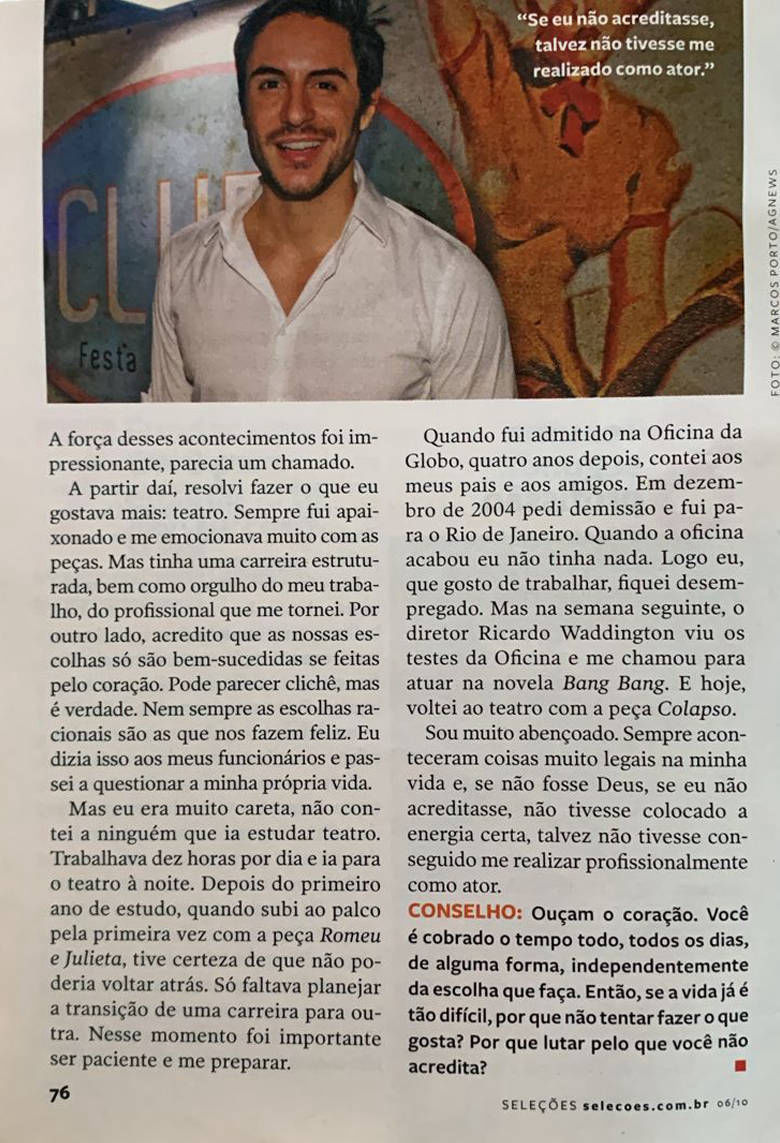
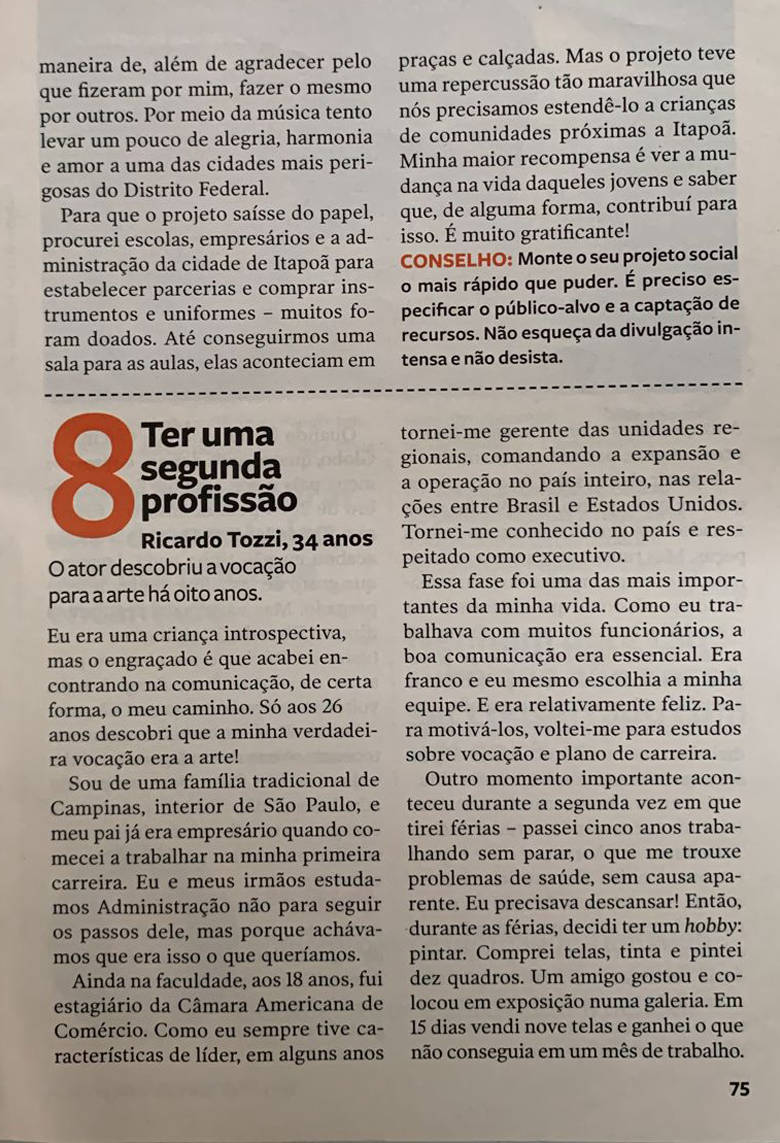
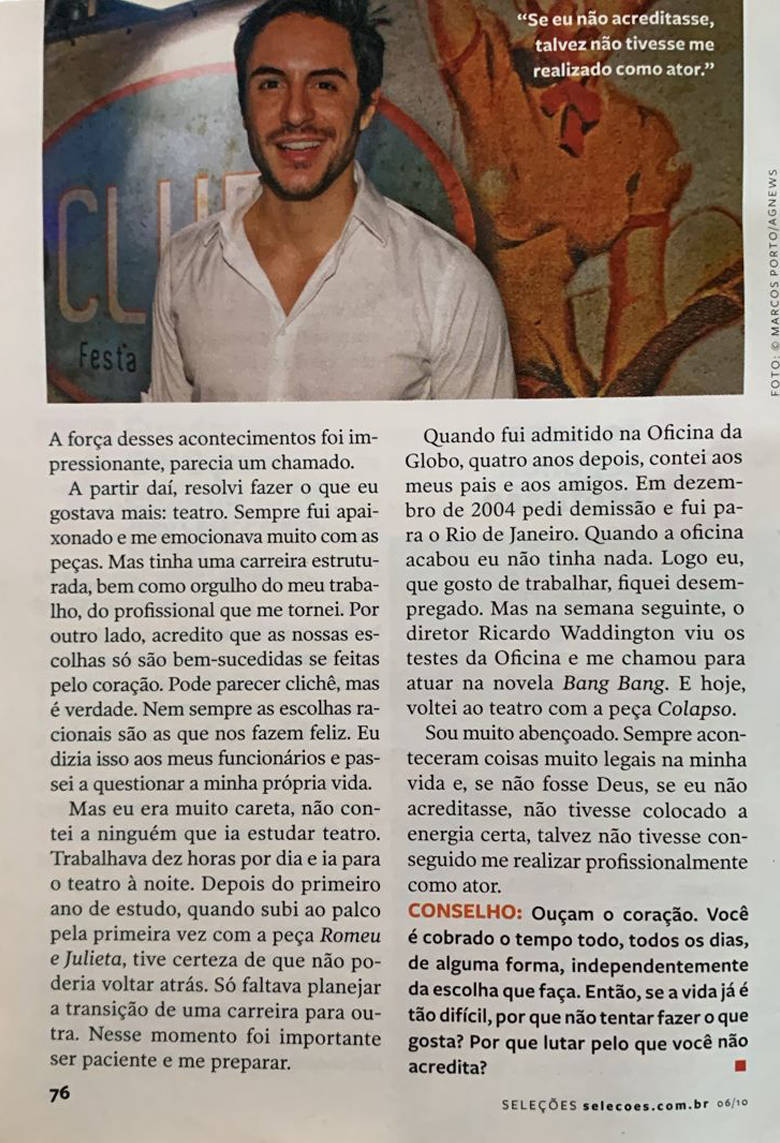
Ricardo Tozzi, 34 years old: The actor has discovered his calling for art 8 years ago.
I was an introspective child, someone that used liked to be quiet, to imagine. And the funny thing is that I ended up finding my path in communication, in a way. But it wasn’t like that until I was 26 years old, when I’ve discovered that my true calling was art!
I come from a traditional family from Campinas, in the interior of São Paulo, and my father was already a businessman when I started working on my first career. My brothers and I studied Business not to follow in his footsteps, but because we thought that was what we wanted in life. While still in the university, I was an intern at the American Chamber of Commerce. As I have always had the characteristics of a leader, in a few years I became manager of regional units, commanding the expansion and operation of 800 employees throughout the country, in relations between Brazil and the United States. I started to become known in the country and to be respected as an executive and I was relatively happy.
For five years I didn’t stop working, which caused me health problems. So, during the holidays, I decided I was going to take up a hobby: painting. I bought canvases and paints and painted 10 pictures. A friend saw them, and put them on display in a gallery. In two weeks I sold nine of them and earned much more than a month’s salary. These facts were very meaningful to me. From then on, I’ve decided to do what I liked most: theatre, as plays have always moved me a lot. Even though I had a structured career and I was proud of the professional I have become, I have always thought that our choices are only successful when made from the heart. It may sound cliché, but it’s true. Rational choices are not always the ones that make us happy.
So, I used to work about 10 hours a day and go to the theatre at night. After the first year of study, when I was on stage for the first time, performing Romeo and Juliet, I was sure I couldn’t go back. I just needed to plan the transition from one career to another.
I waited four years to make my choice public, when I was admitted to the Globo Actors Workshop. A week after it ended, director Ricardo Waddington called me to be part of the cast of the soap opera Bang Bang. Thank God very cool things have always happened in my life. And if I didn’t believe it was possible, perhaps I wouldn’t have been able to work professionally as an actor.
Advice: If you seek self-knowledge, you will be able to listen to your heart. People will demand you all the time, regardless of the choices you make. So, if life is already so difficult, why not try to do what you love? Why fight for something you don’t believe in?